304L Seamless Pipe
304L Seamless Pipe Engineering with Advanced Metallurgy and Operational Dynamics Crystal Cage Structure and Thermodynamic Stability of the 304L Alloy In the world of stainless steel, 304L is an iron‑chromium‑nickel alloy with an “octahedral” crystal structure. In the seamless pipes we offer as Marmara Stainless, this structure ensures the material’s structural stability from freezer temperatures to high thermal values.
The 18‑20 % chromium in the alloy forms a nanoscale passive layer on the metal surface, while the 8‑11 % nickel keeps the crystal structure in a face‑centered cubic (FCC) form, giving the material extraordinary ductility and impact resistance. The low carbon content of 304L (max 0.03 %) prevents the “sensitization” phenomenon during welding.
Because there are few carbon atoms, no chromium‑carbide precipitation occurs at grain boundaries, keeping the pipe’s corrosion resistance homogeneous at the atomic level. This metallurgical purity is the key to the long life of chemical reactors and delicate transfer lines.
Plastic Deformation Mechanics and Fiber Orientation in Seamless Production A seamless pipe is not produced by welding a metal around a circular path; instead, a solid billet is pierced and drawn at high temperatures to extend it. In this process the metal is subjected to enormous radial and axial stresses.
In Marmara Stainless drawn pipes, this manufacturing technique aligns the metal’s fiber structure continuously and circularly along the pipe wall. In welded pipes, the weld line is the region where the fiber structure is cut and metallurgical heterogeneity begins.
In contrast, a seamless 304L pipe, thanks to its monoblock structure, dampens pressure fluctuations and thermal shocks as a single piece. This structural integrity is the most fundamental element that delays metal fatigue in high‑frequency vibrating motor sections and hydraulic lines.
The natural orientation of the fiber structure gives the pipe balanced mechanical resistance in every direction. Fluid Mechanics: Inner Surface Morphology and Friction Losses In engineering projects, pump efficiency and pressure drop calculations are directly related to the pipe’s inner surface roughness (Ra value).
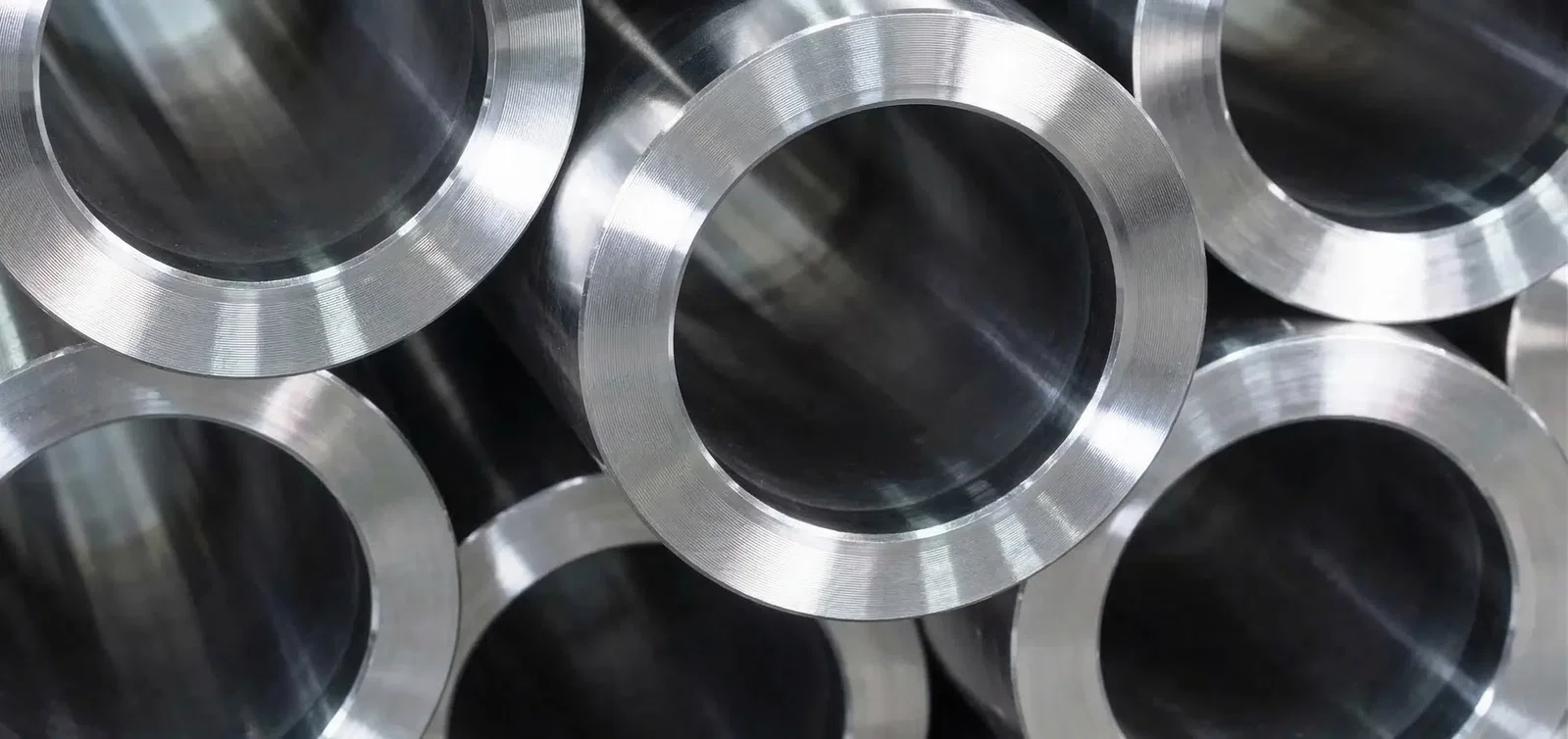
Marmara Stainless’s cold‑drawn 304L seamless pipes, produced by passing through molds, have a mirror‑smooth inner surface. In welded pipes, weld remnants or internal burrs disturb laminar flow, causing turbulence.
Turbulence not only means energy loss but also triggers “erosion corrosion” when particles in the fluid strike the pipe wall. The seamless pipe’s smooth morphology minimizes the friction factor in the Darcy‑Weisbach equation, maximizing overall hydraulic efficiency and providing long‑term energy savings.
In lines with high flow rates, the smooth inner surface is the biggest factor determining pipe life. High‑Pressure Environmental Stress (Hoop Stress) Analysis and Safety Factors In pressure vessel and piping codes (e.g., ASME B31.3), the design factor for seamless pipes is always 1.0.
In welded pipes, due to possible defects at the weld line, this factor is reduced to values such as 0.85. The 15 % theoretical advantage offered by Marmara Stainless 304L drawn pipes actually means that, in practice, they can carry higher pressure with thinner wall thickness or operate with a much higher safety margin at the same wall thickness.
In a cylindrical body, environmental stress from internal pressure is evenly distributed along the entire wall in a seamless structure. A 304L drawn pipe without any weld line shows much more stable and predictable results in burst‑pressure tests compared to its welded counterparts.
This is a structural safeguard that prevents pipe rupture against sudden pressure surges in critical hydraulic systems. Biofilm Formation and Metallic Contamination Control in Food and Pharmaceutical Industries In sterile production processes, the pipe’s inner surface must be free of valleys and peaks where microscopic bacteria could attach.
The 304L seamless pipe, due to its molecular‑level homogeneity, offers one of the most resistant surfaces to biofilm (bacterial film) formation. Products supplied by Marmara Stainless are used especially in dairy, alcoholic beverages, and pharmaceutical active‑ingredient transfer.
The low carbon content of the 304L alloy protects the pipe against caustic and acidic solutions used during cleaning. The smoothness of the seamless structure ensures 100 % chemical contact on the surface in CIP (Clean‑in‑Place) systems, guaranteeing complete sterilization.
Moreover, the material’s purity minimizes the risk of metal‑ion leaching into the fluid, which is essential for maintaining the final product’s chemical purity. Thermal Expansion and Conductivity Optimization in Heat Exchangers (Shells) In heat‑exchanger tubes, the material bridges two different temperature zones.
Marmara Stainless 304L seamless pipes, with precise wall‑thickness tolerances (SCH dimensions), provide a uniform heat‑transfer coefficient along the tube. When a welded pipe is used, differences in thermal expansion between the weld line and the main body can lead to “thermal fatigue” cracks after thousands of operating hours.
The seamless pipe, with its single‑piece crystal structure, meets this expansion homogeneously. The 304L alloy’s oxidation resistance slows the formation of “scaling” on the outer surface of heat‑exchanger tubes, keeping heat‑transfer efficiency high for years.
Additionally, the form precision (ovality tolerances) of the seamless structure eliminates leakage risk during tube‑sheet mounting. Non‑Destructive Testing (NDT) Standards and Quality Assurance Protocols Every seamless pipe in Marmara Stainless’s portfolio is not just a physical product but a certified data package.
The Eddy Current test applied to our pipes detects microscopic surface discontinuities, while Ultrasonic Testing (UT) identifies possible voids inside the wall. In hydrostatic tests, the pipe is held under a load 1.5 times the operating pressure to confirm leak tightness.
The data presented with EN 10204 3.1 certification reveal the pipe’s entire technical identity, from chemical analysis to tensile and yield strength. Spectrometric analyses confirm the alloy elements’ accuracy at the atomic level.
For Marmara Stainless, quality is not a coincidence; it is a repeatable engineering discipline and the unshakable guarantee for critical projects. Total Cost of Ownership (TCO) and Sustainability Analysis In project budgets, using 304L seamless pipes may slightly increase the initial investment but drastically reduces the system’s life‑cycle cost.
When accounting for unscheduled downtime due to corrosion, product loss from leaks, and increased maintenance intervals, Marmara Stainless seamless pipes become the most economical solution. Stainless steel’s 100 % recyclability and the seamless pipe’s 30‑40‑year service life support the “green engineering” goals that reduce a project’s carbon footprint.
Choosing long‑lived materials is the biggest step toward ecological balance in a sustainable industry. Marmara Stainless: Your Engineering Solution Partner Marmara Stainless, with its massive stock capacity and expert technical team in Istanbul, is not just a supplier of stainless‑steel seamless pipes; it is the technical partner of your project.
You can rely on Marmara Stainless’s experience for the right SCH selection, pressure calculations, and material compatibility. From aviation to defense, from food to petrochemicals, our products used in Turkey’s large‑scale projects push engineering boundaries.
Let’s build tomorrow’s durable infrastructure together today, with the power of stainless steel and the reliability of seamless technology. With Marmara Stainless’s guarantee, lay an unshakable foundation for your projects.