
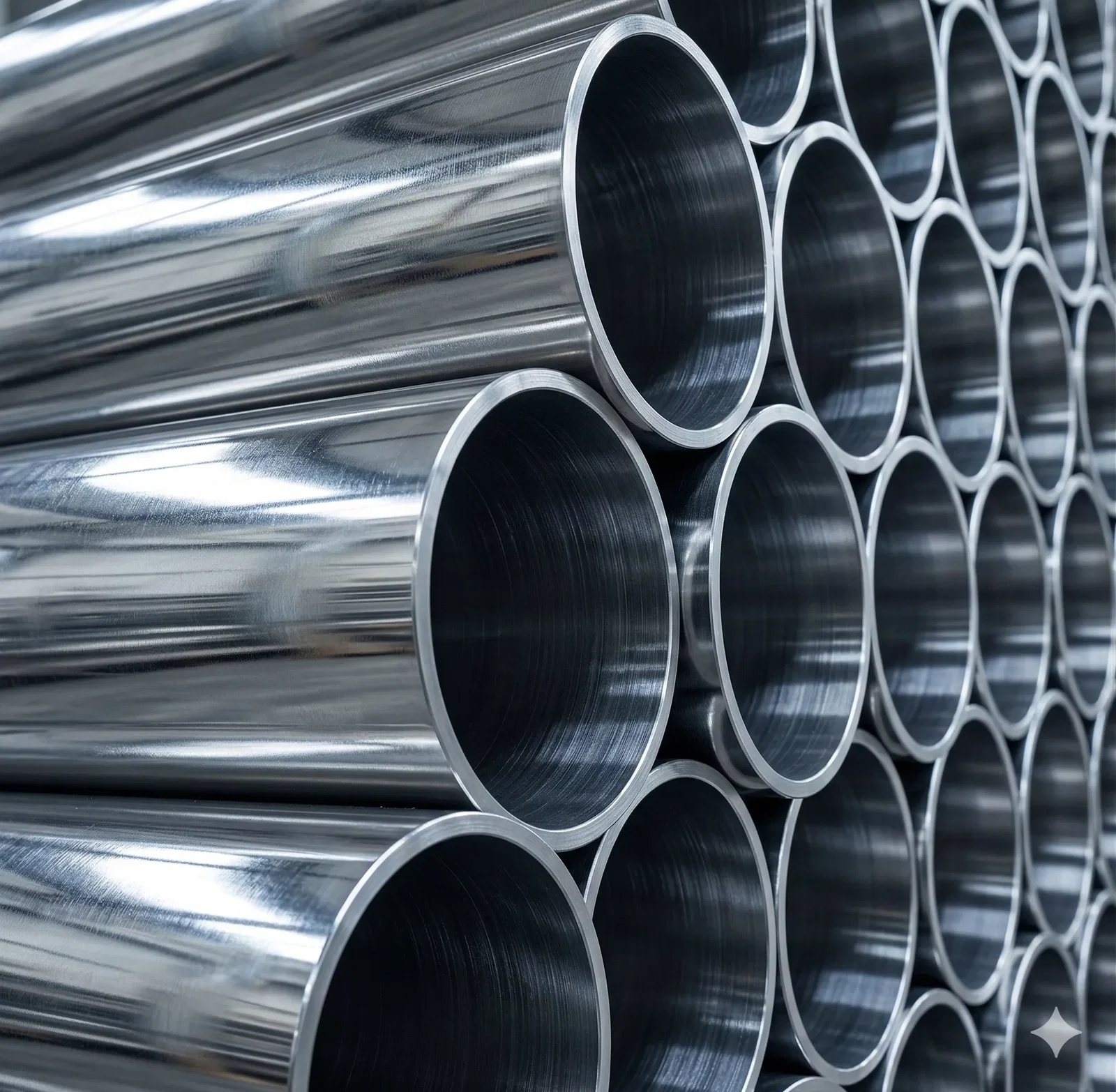
Welded vs Seamless Pipes
Seamless and Seamed Pipe Differences: Technical Comparison, Production Methodology, and Structural Differences Seamed pipes are produced by welding flat steel plates or rolled sheets into a cylindrical shape along their length; in this process, a weld seam runs along the entire body of the pipe. Seamless pipes, also known as "drawn pipes," are obtained as a single piece by heating and drawing a solid round metal billet.
This fundamental difference ensures that the molecular structure of seamless pipes is continuous and homogeneous throughout the entire body. Pressure Resistance and Mechanical Performance The greatest advantage of seamless pipes is their extreme resistance to high internal pressures because they have no weld line.
Since a weld point is theoretically considered a weak link, the seamless structure eliminates that risk entirely. Seamed pipes, although they become quite strong thanks to modern welding technologies, are generally accepted to have an operating pressure capacity of about 80% to 90% of seamless pipes.
Dimensional Accuracy and Surface Quality Because the sheet metal used in the production of seamed pipes is pre‑prepared with precise cold or hot rolling, the wall‑thickness tolerances of these pipes are much more consistent than those of seamless pipes. In seamless pipes, micro‑level irregularities in wall thickness can arise from the drilling and drawing processes during production, but this does not create a disadvantage in heavy‑industry conditions.
Cost Effectiveness and Supply Processes Due to the simpler and faster production process, seamed pipes offer a much more economical solution and are more readily available in the market compared to their seamless counterparts. The production of seamless pipes requires high energy, specialized equipment, and complex metallurgical processes, which significantly increase their cost; therefore, they are chosen only for critical projects where technical necessity exists.
Applications and Sector Preferences Seamed pipes are typically the first choice for decoration, furniture, low‑pressure water lines, automotive chassis, and general construction work, while seamless pipes are indispensable in areas requiring high safety. Petrochemical plants, nuclear power plants, high‑pressure steam boilers, hydraulic systems, and drilling equipment rely solely on seamless pipe technology for leak‑proofing and explosion risk mitigation.
Corrosion Resistance and Chemical Stability In pipelines carrying chemical fluids, seamless pipes are longer lasting because they do not contain the potential corrosion (intergranular corrosion) risk that can arise in the weld region. Although seamed pipes can be homogenized through post‑weld heat treatment (annealing), the integrity of a seamless structure always provides a higher safety margin in environments containing aggressive chemicals.