
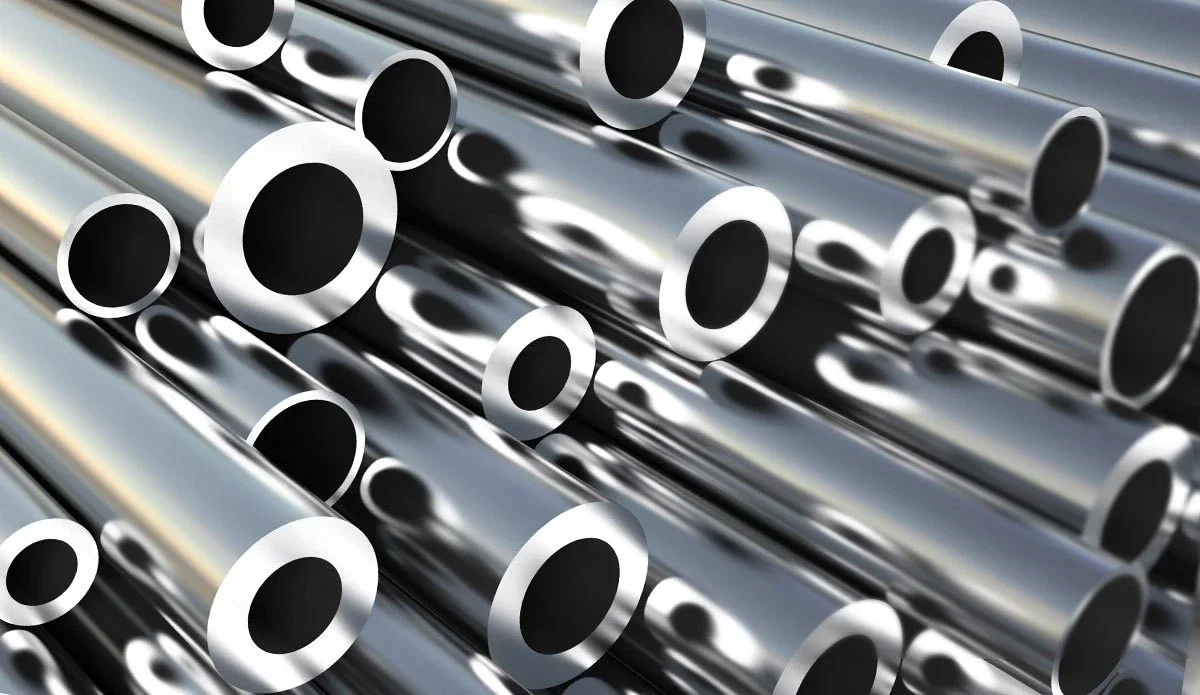
What is Stainless Pipe?
What is a Stainless Steel Pipe? Their durability, corrosion resistance, hardness, and continuity are high, and they have a long lifespan.
They are resistant to high temperatures, pressure, and irritating liquids and gases such as saltwater and acid. Stainless steel pipes are divided into two types: welded (seamed) and seamless (drawn).
Where are stainless steel pipes used? - Shipbuilding Industry - Food Industry - Defense Industry - Refinery - Petrochemical Industry - Construction - Fire Suppression Systems In some sectors, products that can withstand high temperatures are preferred, while in others, corrosion and high-pressure resistance are the main criteria for product selection.
Wherever iron-steel product pipes are used, stainless steel pipes can be used. However, in places where stainless steel pipes should be used, iron-steel products must never be used.
For example, in shipbuilding, stainless steel pipes must be used because ordinary steel products will not meet the requirements in terms of corrosion, tensile strength, pressure, and temperature resistance. In addition, because stainless steels contain low carbon, the carburation is minimized during welding.
Welded Stainless Steel Pipe - The production of welded pipe begins with cutting rolled sheet metal into the specified width. The cut sheet metal first takes a “C” shape thanks to forming machines.
Then, each bent end is shaped in the forming machines until the two ends meet. These two ends are joined in a straight line by HF welding, TIG welding, or laser welding, depending on the industrial application.
- 1. TIG Welding: The joint is heated via an electrode and the electrode is filled between the two sheet pieces.
- 2. HF Welding: The process of joining the ends of the sheet by applying high heat.
- 3. Laser Welding: A welding method that uses a concentrated laser beam to join stainless steel sheets.
This method offers high precision, fast processing time, and minimal heat impact. It also provides a smooth weld without cracks, stains, or deformation on the weld surface.
- In areas where low‑flow liquids or gases must pass through, in interior or exterior spaces for decorative purposes, in hygienic food and chemical production, in yachts and ships, and on polished, satin, stone, or matte surfaces, it can be produced. - Production Sizes: Diameter from 2 mm to 1600 mm, wall thickness from 0.10 mm to 80 mm, available in various forms.
Seamless (Drawn) Stainless Steel Pipe - The production process of seamless pipe starts with shaping hot‑rolled steel into a more workable state and then casting it. It is then stretched, drawn, or pulled over a form.
The hollow pipe then undergoes an extrusion process forced by a die and mandrel. In short, seamless pipes are produced by removing a section from the inside of a solid material at the appropriate temperature and internal diameter.
- Thanks to the homogeneity in its microstructure, the strength of seamless pipes is higher than that of welded pipes made by rolling and welding, but the production cost is also higher. - Seamless pipes are used in heavy industry and high‑pressure applications.
They have very high resistance to corrosion and can maintain their strength at high temperatures. - Because they are used in heavy industry, the surface of drawn pipes cannot usually be polished or ground.
They are produced with a matte surface only due to hot drawing. - Production Sizes: Diameter from 4 mm to 609.6 mm, wall thickness from 1 mm to 50 mm.
Differences Between Welded and Seamless Pipes - A seamless drawn pipe is produced by heating a steel billet until it liquefies, pouring the liquid into molds to form cylindrical metal blocks of the desired dimensions, and then removing the internal area by extrusion or special rolling methods. Welded (seamed) pipes are produced by rolling steel into a roll and welding it longitudinally.
- Seamless pipes have no weld. Welded pipes have a relatively weak area at the weld seam that is more susceptible to corrosion.
Seamless pipes perform better at higher pressures because they lack a weld seam. - Welded pipes require a durability test for the weld portion.
Seamless pipes do not have a weld, so such a requirement is unnecessary. - Although seamless pipes are more expensive due to production costs, they are longer‑lived than welded pipes because of their high durability and corrosion resistance.
- Seamless pipes can be used in place of welded pipes. However, using a welded pipe in places where a seamless pipe is required is not always correct.