
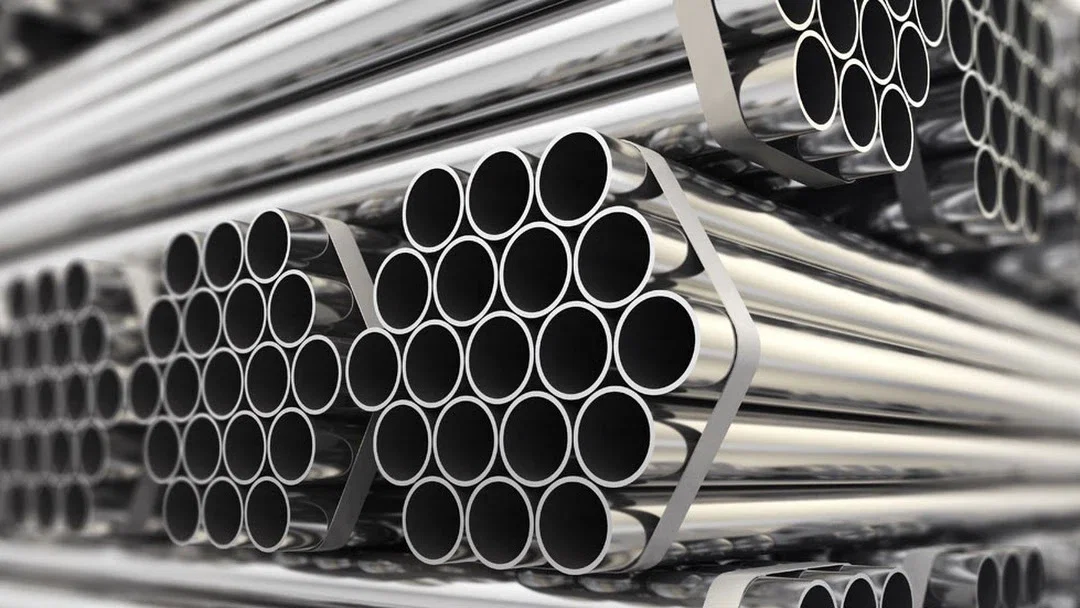
What is Stainless Steel?
WHAT IS STAINLESS STEEL? Stainless steel is a steel alloy known for its corrosion resistance, containing at least 10.5% chromium and less than 1.2% carbon.
The chromium content above 10.5% in the composition reacts with surrounding oxygen and moisture to form a chromium oxide layer on the steel surface that provides corrosion resistance and can self‑repair. This chromium oxide (Cr₂O₃) layer that envelops the steel surface to protect it from rust has a thickness between 1 and 3 nm.
⦁ Stainless steel does not corrode or rust and does not leave water stains like ordinary steel. ⦁ The chromium content and the passivation level determine the steel’s resistance to corrosion and rust.
In stainless steel compositions, the most important alloying element after chromium is nickel. Nickel is the primary alloying element in heat‑resistant steels and increases the steel’s oxidation resistance.
Other elements added to enhance the properties of stainless steel include molybdenum, vanadium, tungsten, selenium, and nitrogen. The other elements added to improve steel properties are nitrogen, molybdenum, vanadium, tungsten, and selenium.
MAIN GROUPS The most prominent feature of stainless steel is its high corrosion resistance. The primary substances responsible for this resistance are nickel and chromium.
These elements form a thin layer on the steel surface and prevent direct contact between the steel and corrosive materials. However, stainless steels also have different quality classes.
Therefore, it is not possible to say that every steel is equally stainless. While stainless steel classes are classified based on the proportion of each element they contain, the percentages of iron, chromium, nickel, molybdenum, and carbon help determine the grade of stainless steel.
Additional elements are added to stainless steel to achieve various properties such as increased corrosion resistance, low‑temperature resistance, high‑temperature resistance, improved weldability, and enhanced strength. Doubly stainless steels are the type of stainless products with the highest corrosion resistance at this point.
Products made from this material, which has a high nickel content, provide trouble‑free use for many years even under the harshest conditions. 300‑grade stainless steels, while not having corrosion resistance as high as duplex steels, still possess good resistance.
This stainless class is the most produced and also the most used austenitic class worldwide. AUSTENITIC STAINLESS STEELS (300 SERIES) Austenitic steels are the most widely used steels, with a basic composition of 16‑26% chromium, up to 35% nickel, and up to 0.40% carbon.
The 200, 300, and 304 series exist, with 304 being the most commonly used among them. Their prominent features are that they are non‑magnetic and cannot undergo hardening heat treatment.
They account for about 70% of the total stainless family. Main application areas include machine manufacturing, shipyards, chemical and food plants, kitchen utensils, and decoration.
⦁ By adding (+) molybdenum (Mo) to 304‑grade steels, 316/L grades are obtained. The 'L' suffix at the end of the grades (e.g., 304L, 316L) indicates that the carbon content has been reduced and weldability increased.
⦁ Provides resistance to localized corrosion in acidic environments. ⦁ High‑chromium grades such as 309 and 310 should be preferred in high‑temperature and flame‑contact environments because their durability is higher than that of other grades.
⦁ The thermal conductivity of stainless steel is 10 times lower than that of aluminum and 4 times lower than that of steel. AUSTENITIC STAINLESS STEELS (321 GRADES) By reducing carbon (C), increasing nickel (Ni), and adding titanium (Ti), 321 grade steels have been made to withstand higher temperatures than the 304 series and to increase wear resistance.
Balancing the natural carbon (C) content present during alloy production is difficult. ⦁ It has good formability even in the cold state.
⦁ Austenitic steels have a flexible and tight internal structure. ⦁ Because the carbon in the alloys is reduced, they do not harden in heat environments, making them suitable for welded connections.
⦁ On the other hand, due to low thermal conductivity and high expansion, the heat input in welding should be kept low to prevent warping or distortion of the material. ⦁ Although each grade may not be separate, the group exists in all forms.
FERRITIC STAINLESS STEELS (430, 442) Ferritic stainless steels are Fe‑Cr alloys that cannot be hardened. They contain up to 0.20% carbon and 11‑30% chromium.
Their most prominent feature is their magnetic properties and rapid corrosion in damp environments. Main uses include kitchen utensils, automotive parts, exhaust components, and hot water boilers.
MARTENSITIC STAINLESS STEEL (410, 420, 431) Martensitic stainless steels are steels with a carbon content up to 1.2% and chromium content between 11‑18%. They have a medium‑toughness corrosion resistance.
The most important feature is the ability to be hardened by heat treatment. The martensitic group’s ability to harden is ideal for use in places where high tensile, friction, and fatigue resistance is required.
Main uses are cutting tools. This steel is mostly used in turbine blades, knives, and surgical instruments.
As in other stainless steels, the most common use of martensitic steels is in industrial applications. Even though there is a medium‑level corrosion risk, it is possible to find martensitic stainless steel in areas where high‑level durability is required.
Because of its high heat resistance (up to 650 °C), martensitic steels are used in thermal power plants. In many industrial kitchen appliances and the production of many kitchen utensils and cutlery sets, the use of martensitic steel is also employed.
DUPLEX STAINLESS STEELS (1.4462, 1.4410, etc.) Duplex stainless steels are steels with a chromium content of 18‑28% and a nickel content of 5‑8%. These steels generally contain 2‑4% molybdenum, giving them good strength as well as toughness.
Main application areas include chemical equipment manufacturing, petrochemicals, paper, and shipbuilding industries. STAINLESS STEELS THAT CAN BE HARDENED BY DEPOSITION (1.4462, 1.4410, etc.) Stainless steels that can be hardened by deposition contain alloying elements that allow the steel to harden through a solid‑solution and precipitation (deposition) heat treatment, similar to aluminum.
These steels are also divided into subgroups such as martensitic, semi‑austenitic, and austenitic precipitation steels.